<body><script type="text/javascript"> function setAttributeOnload(object, attribute, val) { if(window.addEventListener) { window.addEventListener('load', function(){ object[attribute] = val; }, false); } else { window.attachEvent('onload', function(){ object[attribute] = val; }); } } </script> <div id="navbar-iframe-container"></div> <script type="text/javascript" src="https://apis.google.com/js/platform.js"></script> <script type="text/javascript"> gapi.load("gapi.iframes:gapi.iframes.style.bubble", function() { if (gapi.iframes && gapi.iframes.getContext) { gapi.iframes.getContext().openChild({ url: 'https://www.blogger.com/navbar/14058325?origin\x3dhttp://croydonian.blogspot.com', where: document.getElementById("navbar-iframe-container"), id: "navbar-iframe" }); } }); </script>

A vintage Hansard trawl, featuring 'the truth about the navy', troublemaking foreign types and mudguards

Tuesday, June 15, 2010
Cost over-runs - a lot older than government IT projects.  At least 150 years older....

COLONEL WILSON PATTEN ....During the lifetime of the late Sir Charles Barry various steps were taken more or less ineffectually, in order to ascertain when the Houses of Parliament would be finally completed. Like the clock just alluded to by the hon. Member for Peterborough, the Houses, commencing at an estimate of £750,000 had already cost the nation £2,400,000. Now, at the death of Sir Charles Barry it became an object of special interest to the public to know whether the works wore completed; if not, how much remained to be done; and what would be the extra cost.
My wicked fellow republicans:

MR. W. EWART

said, he would beg to ask the First Commissioner of Works whether more seats round the larger trees in Kensington Gardens and the Parks can be placed there for the accommodation of the public; also, whether the large piece of ground lately used as a reservoir for one of the Water Companies, opposite Grosvenor Gate, can be thrown into the Park for the use of the public; and whether the unsightly iron railing round the Statue of King Charles I., at Charing Cross, might not be advantageously removed? 


Mr Cowper
He quite concurred, he might add, with his hon. Friend in condemning the unsightly iron railing which surrounded the statue of Charles I., and he knew of no necessity for its being continued. It was a work of ancient date, and had been erected probably from a feeling that some of the mob might at that time be disposed to mutilate the statue as being an emblem of principles of which they disapproved.
 Maoris, thousands of 'em:

LORD ALFRED CHURCHILL

in rising to put a Question on this subject, said the disturbances to which he wished to call the attention of the House had their origin in the circumstance that a native chief had taken it upon himself to endeavour to prevent the sale of a plot of land in the province of New Plymouth, with which the owner was desirous to part. To such interference the Government of the colony could not, of course, submit, and martial law had been proclaimed in the province. The consequence had been that the Europeans had been brought into collision with the natives, and it being recollected that a number of the settlers were at some of the outlying positions, a force of about 265 strong, including volunteers, colonial militiamen, and some men of the 65th Regiment, had been sent out to secure their safety....There could not be the slightest doubt that but for the arrival of Captain Cracroft and his blue jackets— who deserved all honour for their gallant conduct—these unfortunate settlers would have been cut to pieces during that night, being short of ammunition....He had received a letter from a gentleman largely connected with the colony, which stated:— "The European population of that province is only about 3,000 souls. The lands are principally held by the natives, who appear to have been encouraged to resist the sale of them by Europeans of the very vilest character who have settled among them, such as runaway convicts, sailors of different nations, and others, who, preferring a life of licentiousness, have lived among the natives, and encouraged them, not only by their advice but by subscriptions, to resist the Queen's authority."

Sailors of different nations, eh?

Fast forwarding some 50 years, and it is still those dodgy foreigners with their dodgy foreign ways causing trouble to the military and so forth:


Mr. RIDLEY asked the First Lord of the Admiralty whether his attention had been called to a case which came before the Rochester magistrates on Tuesday, 7th June, in which a Dutchman named Van Drunnen, in the employ of a Dutch firm of shipbreakers engaged in breaking-up His Majesty's ship "Anson," was fined 2s. 6d. and 15s. costs for assisting British bluejackets to improperly absent themselves from duty at Chatham Dockyard by rowing them across the river in his boat; and whether he would give instructions that in future when any British ships were to be broken up the work should be given to British hands?

 Mr. McKENNA The answer to the first part of the question is in the negative. It would not appear that any stipulation such as that suggested in the second part of the question would have any effect in the prevention of such an occurrence as that referred to in the first part of the question, and no additional restriction of that nature is proposed.

Helpful, Mr McK, very helpful.

Big tease o' the day:

Mr. MIDDLEMORE (for Mr. Meysey-Thompson)  asked the First Lord of the Admiralty whether he has read the book styled "The Truth about the Navy" which was issued by Admiralty Order to the men's libraries on His Majesty's Fleet in 1906; whether he is aware that it contains matter of a political character, also sentiments with regard to a friendly nation that might cause irritation; whether he is aware that it contains statements that amount to a defence of Admiralty policy, on which there has been much public controversy; and whether, looking to the fact that these books have been issued to some fleets and not to others, he will order the immediate recall of all these books from the ships' libraries of all the vessels in the Navy?

Mr. McKENNA I believe I read the paper-bound pamphlet referred to in the question two or three years ago, but I have not seen it since, and I am unable to recollect whether it "contains matter of a political character or sentiments with regard to a friendly nation which might cause irritation." As I have no reason to doubt that the title of the pamphlet accurately represents its contents, the statements therein would amount to a defence of Admiralty policy. I do not think the matter is of sufficient importance to justify a consideration of the question whether it should be recalled from ships' libraries.
And can I lay hands on the text of this work?  Nope.


Disturbances in the Euphrates Delta:

Mr. REES asked the Secretary for Foreign Affairs whether he could give the House any information regarding the recent disturbances in the Euphrates delta; and whether the position of the Sheikh of Koweit had been injuriously affected by any of the reported or unreported hostilities between the Arab tribes at the head of or along the southern shore of the Persian Gulf?

The UNDER-SECRETARY of STATE for FOREIGN AFFAIRS (Mr. McKinnon Wood) Some hostilities have occurred between the forces of the Sheikh of Koweit aided by Bin Saoud and those of Sheikh Sadur of the Muntafik tribe, after which the former retired. We have no information to show that the position of the Sheikh of Koweit has been injuriously affected by these occurrences.

Not quite 'the mother of all battles' then.

The vexed issue of 'mudguards':

Mr. REES asked the Secretary of State for the Home Department whether he will consider the propriety of requiring the provision in the case of motor-driven vehicles of front mudguards of such a character that vehicles to which they are fitted would push in front instead of overrunning obstacles before them?

The SECRETARY of STATE for the HOME DEPARTMENT (Mr. Churchill) The question of imposing such a regulation on motor vehicles generally is one which comes within the province of the Local Government Board. But if my hon. 1309 Friend is referring to motor omnibuses licensed in the Metropolitan Police District, the answer is that the Commissioner of Police has from the outset impressed upon proprietors the importance of providing a suitable guard, and has intimated to them that when one is available certain concessions will be made as to the minimum road clearance of these vehicles. No satisfactory device, however, of the nature indicated has yet been submitted to him.

Mudguards?  They sound more like snowplough / cowcatcher type things to me.

Great defunct job titles of our time:

Mr. HUGH BARRIE asked whether it is in contemplation to fill the post about to be vacated by Sir George P. O'Farrell, inspector of lunatics, by the appointment of a candidate who is thoroughly conversant by training and experience with the administration of lunatic asylums and the practical treatment of the insane?

Mr. BIRRELL  Yes, Sir.

Birrell is to be applauded for his brevity.  I envy O'Farrell his business card.

Gratuitous chart o' the day:

Mr. LONSDALE asked the number of persons in Ireland who were boycotted at the beginning of each month of the present year, January to June inclusive, under the headings, respectively, of wholly boycotted, partially boycotted, and minor boycotting?

Labels: , ,

The briefest of vintage Hansard trawls:

Tuesday, June 01, 2010
Those economic migrants, 1860 style:

"MR. H. B. JOHNSTONE called attention to the fact of some hundreds of English artisans leaving our dockyards for the purpose of obtaining employment at Cherbourg, where it was reported that they were paid much higher wages than they received in this country. In the absence of the noble Lord, the Minister for Foreign Affairs, he would defer the consideration of the question until Monday. 

Sensible fellows, those artisans.

Labels: ,

The vintage Hansard trawl, featuring the four crooks elected to serve, Garibaldi, limits to the working week and an early outbreak of a troughing MP.

Tuesday, May 18, 2010
Starting with 1860:


"MR. HENNESSY said, he rose pursuant to notice to call the attention of the House to the Statement by the Solicitor General with reference to an advertisement in The Times newspaper for raising money to assist the insurgents in Sicily, and to call attention to a decision of the Court of Common Pleas as to the illegality of such a proceeding....The hon. Member (Mr. Grant Duff) who introduced the subject frankly owned he wished success to the revolt, and hoped that, spreading into the main land it would before long overwhelm the King and Government in utter, destruction. The hon. and learned Gentleman, in replying, said:— "The question was, whether the subscribing of money by any of Her Majesty's subjects in this country or paying it into the hands of a foreigner living here with the purpose and object described, came within the rule of common law, or was an offence against any prohibitory statute. Now, it appeared to him that, as long as what was done was limited within the bounds of a mere subscription in this country, such as this advertisement prescribed, no law of this country would be violated...Any man who thought [it] proper might put his hand into his pocket [to] take out his money and put it into the hands of another on the faith of its going to Genoa to be disposed of by General Garibaldi, without violating any law whatever".

Can't say I am entirely up to speed on the current law on this sort of thing, but I will give very short odds that such adverts and actions would be remarkably illegal these days.


Lord H. CAVENDISH-BENTINCK
asked the Minister of Labour whether he will arrange so that the Bill to limit the hours of labour to forty-eight per week, introduced by several hon. Members, be either adopted by the Government or given facilities for its passage into law at the earliest possible opportunity?
Sir. R. HORNE
The Government proposes to introduce at an early date a measure dealing with the same matter and the suggestion of my Noble Friend accordingly cannot be adopted.  
They just can't leave well alone, can they?

A question that might have been phrased better:

 Sir B. FALLE asked the Secretary of State for Foreign Affairs if he can say if  the Serbs have any right to occupy Gusinje; if they have occupied Vermoshi, the summer grazing ground of the Albanian tribes; and what will be the result of such occupation?          
A bit of digging shows Vermoshi to be at the Northern extremity of Albania, just over the border from Montenegro.  If Albanians can digest grass, I'm impressed.

Anyway, further on in the exchange:

Lord H. CAVENDISH-BENTINCK
Can the Government take no steps at all to safeguard the Albanians from ill-treatment on the part of the Serbians?
Colonel WEDGWOOD
Is it not the duty of the British Government to protect the Moslems in Albania against ill-treatment of this sort, in view of the fact that the British Government is the greatest Moslem Power in the world? 
For what it is worth, I very much doubt that this is the year as advertised, judging by this:

Lord H. CAVENDISH-BENTINCK asked the Under-Secretary of State for Foreign Affairs whether, in view of the many charges and counter-charges levelled, not only against the Bolsheviks but against Admiral Koltchak, General Denikin, and the White Guards in Finland, the Government will appoint a committee of Members of Parliament to investigate these charges and to issue from time to time impartial and trustworthy statements as to the position of affairs in Russia?

Mr. HARMSWORTH  I have given careful consideration to the hon. Member's proposal, but, as at present advised, I have grave doubts whether any useful purpose would be served by the appointment of a committee of the nature he suggests.

Colonel WEDGWOOD  Is it possible for the Government to issue a White Paper detailing the results of the White Terror in Finland and the Ukraine as a parallel to their White Paper on the Red Terror in Russia?
Either the date is very wrong, or some of our Parliamentarians could have made a killing on the nags or the stock market judging from their ability to read the future.

Not especially time-sensitive, but plus ca change etc:


    Mr. SPENCERasked the President of the Board of Trade whether he can take any action to secure for Members of this House travelling on railways and holding season tickets the privilege of travelling on alternate lines?
    Mr. BRIDGEMAN  Regulations, of which I am sending the hon. Gentleman a copy, are in operation in. regard to the interavailability of season tickets, and I am afraid that I cannot secure their modification in favour of Members of Parliament.

    Major WOOD In view of the desirability of hon. Members being able to keep in close touch with their constituents; will the hon. Gentleman consider the desirability of giving them free passes?
    Mr. BRIDGEMAN
    I will represent to the proper authorities the desire expressed by my hon. and gallant Friend.

The doubtless gallant Major sat for Aberdeenshire and Kincardineshire Central (in the Liberal interest), so his desire for a freebie is understandable, if not wholly laudable.

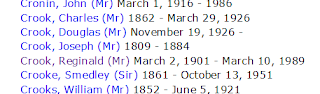
Meanwhile, as an off-meter treat, readers should hie themselves here to see if there have been any parliamentarians sharing their surnames.  No matches for me, alas.  Our PM is the seventh Cameron, by the look of it.  There have been *ten* John Smiths, and three John Smyths.   And there have only ever been four Crooks in Parliament:


Reg was a Socialist, as is Doug, Joseph a Whig / Radical (nomenclature varies) and Chas was one of my lot, despite being elected to the less than leafy seat of  East Ham North in 1922.  

Labels: , ,

A bit of historical perspective, or the long awaited return of the vintage Hansard trawl

Thursday, May 13, 2010
Starting with 1860:

Lunatics in Scotland

With a wonderfully irrelevant addendum:
     
MR. E. ELLICE (St. Andrews) said, he rose to ask the Lord-Advocate, Whether he intends at an early period to propose a Bill for establishing greater uniformity in the interpretation of the Law of Scotland as regards the definition of Lunacy; for removing doubts as to the obligation of Counties to provide accommodation for Lunatics; and for giving to the Commissioners in Lunacy extended powers with regard to the custody of Pauper Lunatics?

THE LORD-ADVOCATE said, it was his intention to introduce a Bill to remedy some of the defects which were found to exist in former Lunacy Acts, and he hoped soon to lay it on the Table of the House.
Given the exciting times of the lion lying down with the lamb etc, readers are invited to choose which political party's Scottish election performance best points to mental health issues North of the Border.

And the add on:
 
"MR. G. W. HOPE said, he rose to say a few words of explanation with reference to a statement he had made when moving for the production of the Civil Service Exanimation Papers a few nights previously. On that occasion he had said that in the case of the particular candidate of whose rejection he complained, there had been but one single mistake in his spelling. He had since been informed that there was more than one mistake. He had also stated that he was unacquainted with the names of the Commissioners. He had now ascertained that two of them were Sir Edward Ryan and Sir John Lefevre, and he might say that if there were any gentlemen whom he would entrust with the duties of such a position with confidence, those were the two he would select".

Onwards:

CAPTAIN GRANT'S MILITARY COOKING INVENTIONS.—OBSERVATIONS


COLONEL LINDSAY said, he rose to draw the attention of the House to the system of cooking in the army invented by Captain Grant, and to ask the Secretary of State for War, if he intends to recommend that some remuneration shall be given to Captain Grant for the great services he has rendered in improving and economising the system. The hon. and gallant Gentleman observed that before those improvements were introduced the only means employed for cooking soldiers' dinners were boilers, and if the men desired to have their food baked they had to take it to an oven in the town where they happened to be, and to pay for it out of their own pockets...The expense of cooking at the present moment varied from ½d. per man per week to 5d. per man per week. But this last was an excessive charge. It occurred at St. George's Barracks, and was caused by the apparatus of cooking by gas, which for military reasons ought to be discontinued. The system which only cost a halfpenny per day per man was that of Captain Grant.  The Army Sanitary Commission...recommended that the means should be furnished the soldiers of having their rations cooked by baking, stewing, and frying.
....
Mr Cave....If a man invented a method of blowing a whole regiment to atoms, he was amply rewarded, and covered with distinction; but if he merely contrived a means of keeping them alive, he was not thought entitled to distinction or reward by the Government of the country
If an army does indeed march on its stomach, I pity our Tommies a non-stop diet of the boiled.


In 1910, our Parliamentarians were mainly concerned with encomia to the lately deceased Edward VII, which does not lend itself to much amusement or facetious asides.  Mind you, how about this for flowery:

"The Douma of the Empire at its sitting of the 26th April (9th May) has charged me with the duty of interpreting to you the sentiments of profound condolence and of sorrowful sympathy which it experiences on the occasion of the decease of His Majesty King Edward VII. The mourning of your country has found a unanimous echo in the representatives of the Russian nation, which loses in the person of the late King a near relative of the Imperial family of Russia, a sure friend and constant well-wisher, a monarch devoted to the maintenance of universal peace. Please convey to the House of Commons the expression of the Sentiments which animate the Douma of the Empire, as well as the profound assurance which it feels that the bonds of friendship between our two countries, which received so powerful an impulse from the great Sovereign who has passed away, will not cease to be developed and strengthened for the greatest good of both nations.   ALEXANDER GOUTCHKOFF, "President of the Douma of the Empire

A bit late, Sandy, we know you volunteered for the Boers in that war.

Meanwhile this little nugget from 1960, prefacing a question about surplus army boots:

Mr. Norman Dodds  (Erith and Cray ford, LAB) The Sixth Report of the Select Committee on Estimates on Treasury Control of Expenditure reports that a very knowledgeable person, Sir Ivone Kirkpatrick, former permanent head of the Foreign Office, had called for a purge of top civil servants who squander public money. In fact, he asked that civil servants who waste public money should be sacked, and he said that many top civil servants are failing to keep a tight hand on the taxpayers' money and should be retired earlier, with revocation of honours granted. That is the view of Sir Ivone Kirkpatrick, who should know.

There are many thousands of people in this country who are asking why top civil servants are not penalised when public money is wasted. People want to know, and I want to know, what does happen to them when millions of pounds are thrown away or lost through lack of initiative or care. Are they punished, and if not, why not? I have asked this question of the Prime Minister, and there does not seem to be any record at any time in recent years of any top civil servant being sacked or in any way penalised when money has been spent and it has been proved that much of it has been wasted. 

I think it should be politicians first, then civil servants

Labels: , ,

A litle light hansard trawling - featuring horror films, creosote and privateers in dog collars.

Monday, March 29, 2010
Starting in 1860.


"Mr Selwyn said, he wished to ask the Secretary to the Admiralty, Whether the Lords Commissioners of the Admiralty intend to recal the Circular of the 2nd of February, 1860, relating to the rank of Chaplains in the Royal Navy, or to alter the Circular so as to make it accord with that portion of the Order in Council which relates to the same subject; and whether the Lords Commissioners of the Admiralty are prepared to make any arrangement, in compliance with the request of the Chaplains, that in choice of quarters, sharing prize money, and taking a passage, they rank with Commanders afloat, or field officers when employed on shore?".

Insert joke about muscular Christianity here...

Lord Clarence Paget - With regard to the choice of quarters, by which he presumed the hon. and learned Member meant cabins, he had to state that Chaplains were always allowed one of the best cabins in the quietest part of the ship. With regard to sharing prize-money and taking rank as commanders afloat, he was afraid the Admiralty could not accede to that proposal. The Chaplains had never ranked with Commanders afloat, but had taken their rank with the Paymasters and Surgeons, and other Officers of that class, and the Admiralty had no intention of altering that arrangement.
Here's an idea:

MR. LINDSAY  said: Sir, I rise to propose the following Motion:— "That an humble Address be presented to Her Majesty, praying that she will be graciously pleased to enter into negotiations with the Emperor of the French, with the view of making a Treaty for the reciprocal abrogation of all discriminating duties levied upon the vessels and their cargoes of either of the two nations in the ports of the other; and for procuring such alterations in the Navigation Laws of France, as may tend to facilitate the Commercial intercourse, and strengthen the friendly relations between England and France."


This might  have obviated any need for the Treaty of Rome, if multiplied a few times....  
How much did creosote cost?


Mr. FRANCE asked the President of the Local Government Board whether he would consider the possibility of extending the period of loan on creosoted fencing used in connection with small holdings to twenty-five years, in accordance with representations made by the Small Holdings Commissioners in different parts of the country, upon the strength of which rents had been fixed by county councils?

The PRESIDENT of the LOCAL GOVERNMENT BOARD (Mr. Burns) Perhaps I may be allowed to refer my hon. Friend to my answer given on the 21st instant to the hon. Baronet the Member for North Dorset, from which he will see that I have been advised that thirteen years is an adequate period to allow for the repayment of these loans.


And all this NOT from the known creosote obsessive of 1909, Mr Courthorpe


How about this for the British motor industry, erm, motoring?


Mr. BIRD  asked the President of the Board of Trade if he would state the number of motor cars with bodies and also of chassis without bodies, all of foreign manufacture, imported into this country during 1909; and the value of the above and the value of the motor car parts and accessories imported from abroad during the same year.

The PRESIDENT of the BOARD of TRADE (Mr. Sydney Buxton)  3,666 motor cars of a declared value of £1,223,053 and 4,855 chassis of a declared value of £1,321,596 were imported into the United Kingdom in 1909, in addition to other parts of motor cars valued at £1,771,960.


And

Mr. BIRD asked the right hon. Gentleman if he will state the value of British-made motor cars and chassis exported from this country during 1909 and the actual total of British-made cars produced in 1909, according to the returns of the British Society of Motor Manufacturers?

Mr. BUXTON  Two thousand five hundred and eighty-three motor-cars and 219 chassis of United Kingdom manufacture were exported in 1909, their combined value being £1,037,787.

Having overturned the Treaty of Rome, maybe Beveridge could have been spared his report:

 Mr. HUGH LAW  asked the Prime Minister whether, in considering the amendment of the Old Age Pensions Act, the Government will bear in mind the desirability of making provision at an earlier age than seventy for persons suffering from permanent physical disabilities?

The PRIME MINISTER  I do not think that this is a matter which should be dealt with by amendment of the Old Age Pensions Act. The Government have had under their consideration for some time past the framing of a contributory scheme for insurance against sickness, invalidity, etc., which it is hoped will to a considerable extent meet cases such as those described by the hon. Member.
As in truly contributory, rather than via a governmental Ponzi scheme.

And so to 1960, wherein Marcus Lipton finds American architectural adornments not his cup of tea.


Mr. Lipton (Lab, Brixton) asked the Minister of Housing and Local Government and Minister for Welsh Affairs when planning consent was given to the erection of an aluminium eagle with a wing-span of thirty-five feet on the American Embasy Building in Grosvenor Square, London.

Sir K. Joseph The design approved by the London County Council included a large cartouche on the facade. It is now proposed to substitute an aluminium eagle. The planning authority is being consulted.

Mr. Lipton Will the hon. Gentleman say what on earth London will look like if all the foreign Governments represented here stick up monstrous national emblems on the buildings they occupy? Is not London already defaced and scarred by all kinds of architectural eyesores and so-called planning improvements, and has not the time come to call a halt?

Oh I don't know Marcus, I think it might be rather fun.


An unlikely take on the position of South Africa in the Commonwealth from a Labour MP:


"Mr Silverman Will the right hon. Gentleman bear in mind that a great many people in this country would desire that, far from withdrawing the invitation, this gentleman should be actively encouraged to come here, and that while he is here he should be given every possible opportunity of seeing democracy at work? 

He had a point, didn't he?

Captain Richard Pilkington  (Poole)
Mr. Speaker, I have to ask you very kindly to switch your attention from pigs and eggs to the problems of some films, bad films. I think the vast majority of people in the country and in this House are very concerned with the growing wave of crime and brutality that there has been since the war. That crime wave has been particularly evident among the young people of our nation, the people to whom we have to look for the leaders of the future.

[much toing and froing over matters of law, procedure etc]

I quote, first, from a review appearing in the Sunday Express of 27th September, 1959. It referred to a film called "The Mummy," at the London Pavilion, and the following sentences are germane, I think, to what I am putting to the House. The review states: But we are now given a flash-back of Princess Ananka, describing the circumstances of her death. The only reason for doing this, as far as I can see, is to give you a close up of the way to cut off a man's tongue. Why put that in? Because the film's makers (Hammer Films), who have made a lot of money out of doing this sort of thing, believe that you will pay to see it—especially if it is in Technicolour. My second quotation is from the Daily Herald of 29th October, 1959, and refers to a film called "Eyes Without A Face," at the Cameo-Royal. It says: The daughter of a famous French surgeon is badly injured … and has 'an enormous wound instead of a face. Only the eyes are intact.' While she lopes about the house wearing a mask, Dad lures girls to his clinic, where he removes their faces and tries them on his daughter for size. He has already been successful with the same trick on dogs. I apologise, Mr. Speaker, for reading some of these details, but the review goes on to say: Finally, the daughter goes mad, and lets loose the dogs, who tear Dad to pieces … The lingering and obscene eye of the camera focusses on the following: The daughter taking off her mask (in close-up); the surgeon drawing a pencil round a girl's face as she lies on the operating table, then tracing the line with his scalpel (in close-up); the surgeon beginning to peel off the girl's face (in close-up); the face of the surgeon after a score of dogs have got at it (in close-up).'Eyes Without a Face' is a piece of revolting, pandering evil rubbish.  The review very rightly comments 'Eyes Without a Face' is a piece of revolting, pandering evil rubbish."
...

Mr. Vosper I was coming to that point. My hon. and gallant Friend referred to horror films. I think the public, on the whole, regard the horror film as a film of a Dracula type. Despite what my hon. and gallant Friend said, and despite the Press criticisms, I think these are somewhat infrequent nowadays. The Board accepts what it regards as legitimate horror films, but it removes scenes which appear to it as disgusting or repulsive, and it invariably places horror films in the "X" category, which means that they must not be shown to children.

Both 'Eyes' and 'The Mummy' are available on DVD with '15' ratings.....


Labels: , , ,

An 1860 Hansard trawl - featuring flogging in the navy, seditious cakes and thae age old dilemma - pub or museum?

Tuesday, February 16, 2010
Autre temps, autre moeurs:

MR. W. WILLIAMS  in rising to call the attention of the House to flogging in the Army and Navy, said the system was most injurious to those services because it prevented respectable men from joining them. Upon their soldiers and sailors the country depended for fame, for honour and for security, and yet under the existing practice our soldiers and sailors were liable, for trivial offences, to receive worse treatment than that given to convicted criminals and felons. By the present law no culprit could be flogged in the public streets except one who had actually threatened the life of the Queen.


Crikey.


The officers who opposed the abolition of this punishment were influenced just as the Judges and Recorders were influenced when it was proposed to humanize our criminal code. "If," they said, "you do away with the penalty of death for a vast number of offences, the country will be overwhelmed with crime." Yet the result had been a diminution instead of an increase of crime throughout the land.

Intriguing, no?

Colonel North (no relation...) took up the 'it never did me any harm approach':

"The hon. Member had year after year complained of flogging in the army and navy. If the hon. Member, or any other civilian who joined in his complaints, could devise a punishment which, while it was, severe, would keep the soldier only a short time away from his duty, he would be hailed with the greatest gratitude by the whole army and navy. What was wanted was a punishment that would not throw extra duty on the well-behaved soldier. He had known many men who did not care for being three months in confinement; and while they were there, who was doing their work? Why, the good soldier, who ought to be protected by the officers instead of having the duties of his disorderly comrades thrust upon him in addition to his own. The hon. Seconder of the Motion had stated that in the Trench army there was no flogging. Did he inquire how crimes were punished in that army? If he had done so he would have found that where we flog the French shoot. Would the English public like a man to be shot for knocking down a non-commissioned officer? Do not then talk about our treating men as brutes, when the French shot where we flogged"

Captain Vernon would not seem to have an opinion of 'our boys':

He need hardly inform the House that those who went to sea or who followed the drum were not the best part of the community, but were men who hung loosely on society, and those men into whose hands arms were put had to be controlled by necessary discipline. The fear and dread of punishment made soldiers good, just as it did civilians. The soldier was a very different man, when once he became a soldier, from any other person. He (Captain L. Vernon) had seen a man shot in the West Indies for doing that for which any hon. Member of that House who was a magistrate would have fined a civilian only 10s. in this country. But why was the man in question so dealt with? Because, the regiment to which he belonged being in a state approaching to mutiny, he struck the adjutant in the presence of his colonel.
A small gem of an anecdote from Lord Russell:

LORD ROBERT MONTAGU  said, he would beg to ask the Secretary of State for Foreign Affairs, "Whether Her Majesty's Government have received any communication from the Government of the Two Sicilies, complaining that agents of the Government of Sardinia have been trying to excite a mutiny in the Troops of the King of Naples?

LORD JOHN RUSSELL  Sir, we have received no information of the kind referred to by the noble Lord, nor has the Government of the Two Sicilies made any complaint of the sort. At the same time, I should tell the noble Lord that that Government is not disinclined to make complaints. Not long ago I received a complaint that an English officer of marines, in paying a visit to a lady at Naples on her birthday, called in at a pastry cook's and bought a cake for her, which cake was said to have had on it three flags of different colours. The Government of the Two Sicilies complained of this as an attempt to excite an insurrection.
Recreation and improvemet of the people:


SIR JOHN TRELAWNY said, he had waived that part of his Motion on this subject which involved any allusion to the Lord's-day, and to the Resolution in its altered shape he believed that no opposition would be raised. His object was to obtain for the people the advantages of the expense already incurred in reference to such institutions as the British Museum and the National Gallery. If these places were open at stated hours on week-day evenings, as was the case now at Kensington, working men would be won from other pursuits highly injurious to their morals, and great benefit would result to the community.

I suspect that the 9th Baronet was being a tad optimistic.

Labels: ,

An 1860 Hansard nugget, featuring duplicitous Gauls and one of the great typos of our time

Wednesday, January 27, 2010
From 27/1/1860

"THE MARQUESS OF NORMANBY inquired of Her Majesty's Government, pursuant to notice, whether they have received any Information as to the Negotiation stated by the Ministerial Journals in Paris to exist between France and Sardinia for the Annexation of the Duchy of Savoy and the County of Nice to the Dominions of the Emperor of the French?...The statements to which he had alluded had appeared in the two principal and habitual organs of the French Government. It was first published in Le Pays, the most careful and prudent of the Ministerial journals; but what had chiefly attracted the attention of Europe was its circulation in the columns of L'Indépendance Beige (sic), a Brussels paper in the enjoyment of Imperial favour, and possessing, perhaps, the most general circulation of any European journal".

See, I'm not making this up:


 (OK, it is an OCR error rather than a typo, but my point stands)

Anyway, enough of the flippancy and on to the more interesting bit:

This [in L'Indépendance Belge] article said that France was now determined by counsel, by her soldiers, and by sacrifices of every kind to substitute for the hereditary arrangements of Vienna the truthful policy of nationalities; and the writer went on to say that it was evident the day was drawing nigh when the superstructure raised by diplomatists must disappear before the power of logic and the course of events.

 Which takes us back to the First Empire and a France that looked like this:


  So, pretty alarming for France's neighbours, it must be said.

As the Marquess reckoned:

He was not aware that there had been any diplomatic declaration to this effect, but the dangers contingent upon the adoption of such a principle by the powerful Government of a great nation were much greater than any which could arise from the annexation of the Duchy of Savoy. Could it for a moment be imgined that England had no interest in the assertion of such a doctrine? Why, let us look at our own possessions, scattered over the face of the globe, and then see how far we could recognize the principle of nationality. How could England stand this test? How would it apply in the Mediterranean, or the Ionian Islands? How affect Gibraltar? How might it be brought to bear on Aden or the Empire of India, or our dependencies in another hemisphere? Why, if such were to be admitted as a valid ground there would not be a single country in Europe the foundation of whose title would not be shaken".

And there's more:

Such a doctrine would be quite subversive of those treaties and of that order and regularity which forty years' peace had brought about. Russia, indeed, prided herself upon her nationality. Nor, as regarded Poland, did he think they could collect the scattered remnants of a national existence. The restoration of Poland to nationality would almost remind one of Mr. Canning's expression regarding the repeal of the legislative union with Ireland: "Repeal the union—restore the heptarchy." Well, then, as to Prussia and this doctrine of nationality—sec how it worked from Posen to Aix-la-Chapelle. Again, witness its application to Austria. And here he must say that he looked upon the stability of Austria as one of the main elements of European security; and he wished that some one who had the same conviction, and had more opportunity of making his opinion known in the proper quarter, would urge how important it was to grant what was just and reasonable in the demands of Hungary. He hoped and believed that, as regarded her Hungarian dominions, the loyalty of the Hungarian people was not yet shaken.

Not a quote I have encountered before, but quite amusing.

France did indeed get Savoy, plus Nice, or Nizza - as a lot of the inhabitants called it  including a VERY peeved Garibaldi - after a rather dodgy referendum later in 1860.  Fans of nemesis might note that the national principle rather bit France with the outcome of the 1870 Franco-Prussian war..... 

Labels: , , ,

150 years ago...

This, from an 1860 Hansard:

Several Members came to the Table to be sworn, and Sir Francis Henry Goldsmid, Member for the Borough of Reading, having stated that being a person professing the Jewish Religion, he had a conscientious objection to take the Oath in the form required by the Act 22 Vict. c. 48:—The Clerk reported the circumstance to Mr. Speaker, and Sir Francis Henry Goldsmid was directed to withdraw; and he withdrew accordingly.

Resolved,— "That it appears to this House that Sir Francis Henry Goldsmid, a person professing the Jewish Religion, being otherwise entitled to sit and vote in this House, is prevented from so sitting and voting by his conscientious objection to take the Oath which by an Act passed in the twenty-second year of Her Majesty has been substituted for the Oaths of Allegiance, Supremacy, and Abjuration in the form therein required."

Resolved,— "That any person professing the Jewish Religion may henceforth, in taking the Oath prescribed in an Act passed in the twenty-second year of Her Majesty to entitle him to sit and vote in this House, omit the words 'and I make this declaration upon the true faith of a Christian.'"
Sir Francis Henry Goldsmid accordingly came to the Table, and was sworn on the Old Testament.

More on Goldsmid here.   Also, a list of historic and current Jewish MPs here, doubtless including ideological heroes / heroines for most respectable shades of opinion.

Labels: ,